


Q+Art is a series featuring the artists behind our First Friday Exhibitions. Today, we’re talking with Philadelphia-based artist Paige L. Morris, whose work is featured in our May 2026 exhibition, Modern Love: Reflections on Intimacy and Eros.
Paige L. Morris builds her work atop fault lines, both social and emotional. The Philadelphia-based artist and educator is guided by what she calls “material poetics,” using glass, sound, and found objects to probe the limits of language and reckon with the complex architectures of love, care, and grief within systems meant to fracture us. “At the core of my practice is a desire to understand who I am outside of the patriarchal and capitalist conditioning I inherited,” she says, “especially through my relationships with myself, others, and the cultural and religious systems that shaped me.”
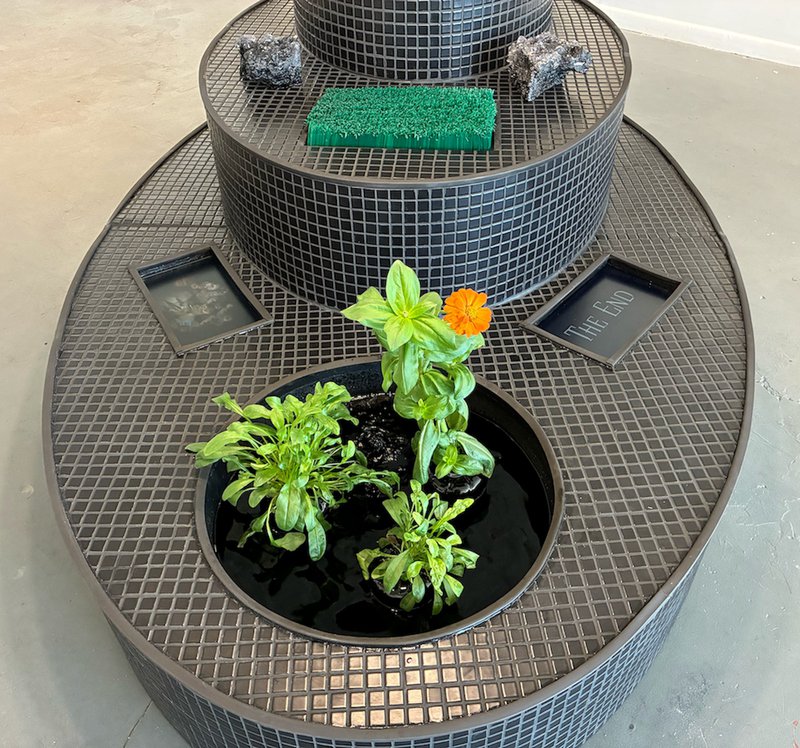
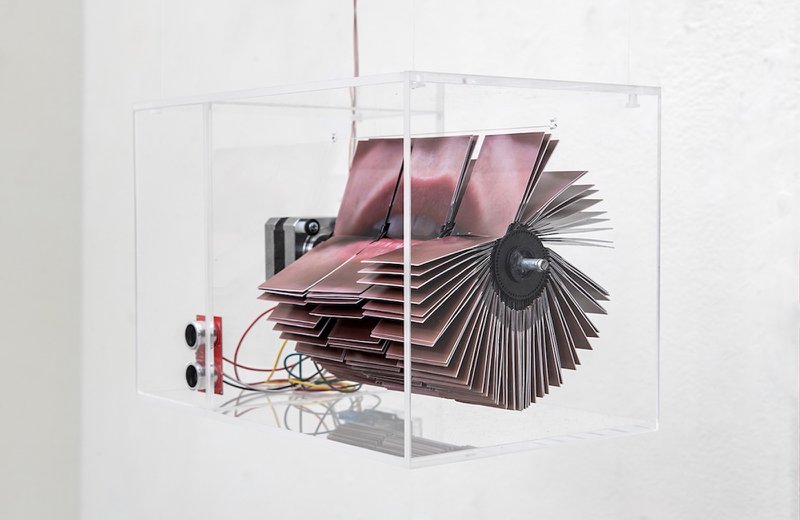
For Paige, the act of making is inseparable from rupture and renewal. Loss—leaving grad school during the pandemic, financial instability, the sudden death of her sister—has pressed itself into her process, turning each project into a cycle of breaking, unlearning, and tentative repair. Her installations often dwell in states of instability: glass that "sheds" when touched, flowers that may never bloom, machines stuck on a loop, repeating “Oh” or “baby” until the words hollow out and fill up again.
In "Here is Where I Leave You," hydroponic systems and living plants demanded ongoing care from viewers, transforming the installation into an experiment in impermanence, collective care, and, following her sister’s unexpected death, grief. The sudden blooming of a pink zinnia—her sister’s favorite color—became, in Paige’s words, “a container for grief and for the strange ways time continues to reshape meaning long after we believe a work is complete… seeing that image so soon after her death fundamentally altered my understanding of the piece.”
With every gesture, Paige’s work resists closure and rejects imposed meaning, finding resonance in what is unstable, unfinished, and evolving. “By foregrounding forms of care that are often invisible or undervalued, I hope to emphasize process over product, collaboration over competition, and attentiveness over perfection,” she says. Informed by her working-class upbringing and experience with artist collectives, Paige’s work asks us to slow down and witness the emotional, communal, and material labor that underpins every bloom, every fracture, every attempt to begin again.
In Today’s Q+Art Interview…
Paige L. Morris reflects on the confessional qualities of glass, how her practice reframes popular notions of productivity, and why focusing less on outcome in the studio is key for her mental health.
You often talk about tracing memories and emotions through objects and gestures in your work. How do personal or shared memories shape the narratives or emotional resonance within your installations?
Paige L. Morris: My work is often sparked by experiences of longing, desire, grief, or uncertainty that continue to replay in my mind long after the moment itself has passed. I use objects and gestures as vessels for those emotional states, translating memory into physical forms.
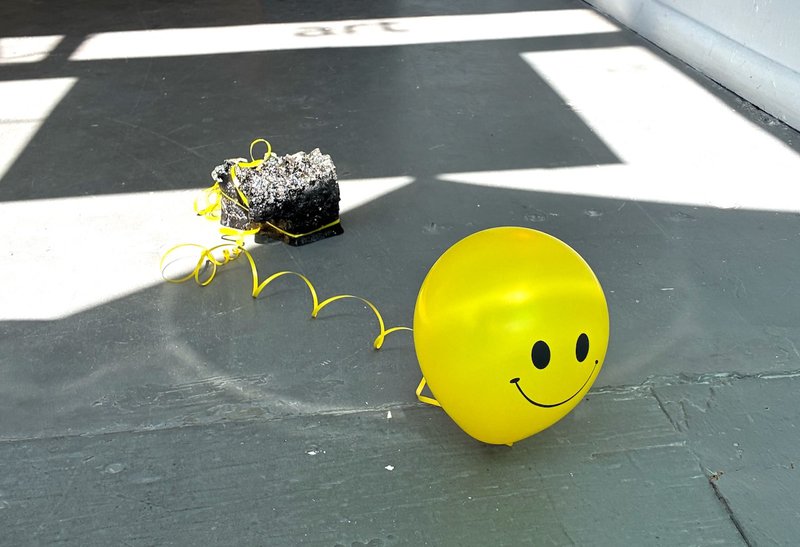
A new work, “People Pleaser,” embodies this dynamic particularly well. The piece pairs a yellow smiley-face balloon with a heavy cast-glass rock, bound together in a quiet tension. As the balloon dances in space, slowly deflating until, ultimately, it finds itself dragging along the floor, its smile never fades. Balancing humor and melancholy, the work explores emotional labor, performance, and the exhaustion that can emerge from trying to remain buoyant under the weight of expectation.
Do you have any creative rituals or routines that help you get started?
PLM: What has helped me continue making, even inconsistently, is reframing my relationship to productivity. I’ve been trying to disentangle my practice from the pressure to constantly produce and self-promote, and instead focus on what allows me to feel grounded and present. That includes my community, my partner, therapy, physical activity, and creating space for rest. By prioritizing my well-being, I’ve found I’m able to return to the studio with more intention, focusing less on output and outcome and more on attentiveness and experimentation.

You’ve said you use materials almost like a kind of poetry, as a way to process and express emotions. Could you give an example of how this has shaped one of your works?
PLM: With my foundation in glass, I’m continually drawn to the contradictions inherent in the material. Glass is an amorphous solid with a liquid-like molecular structure; it exists in an in-between state: fragile yet resilient, transparent yet reflective, controlled yet unpredictable. Even when I work with other materials, I return to this sense of instability and tension as a way to move beyond binary thinking. For me, the material itself becomes confessional; meaning emerges through its physical behaviors and limitations.
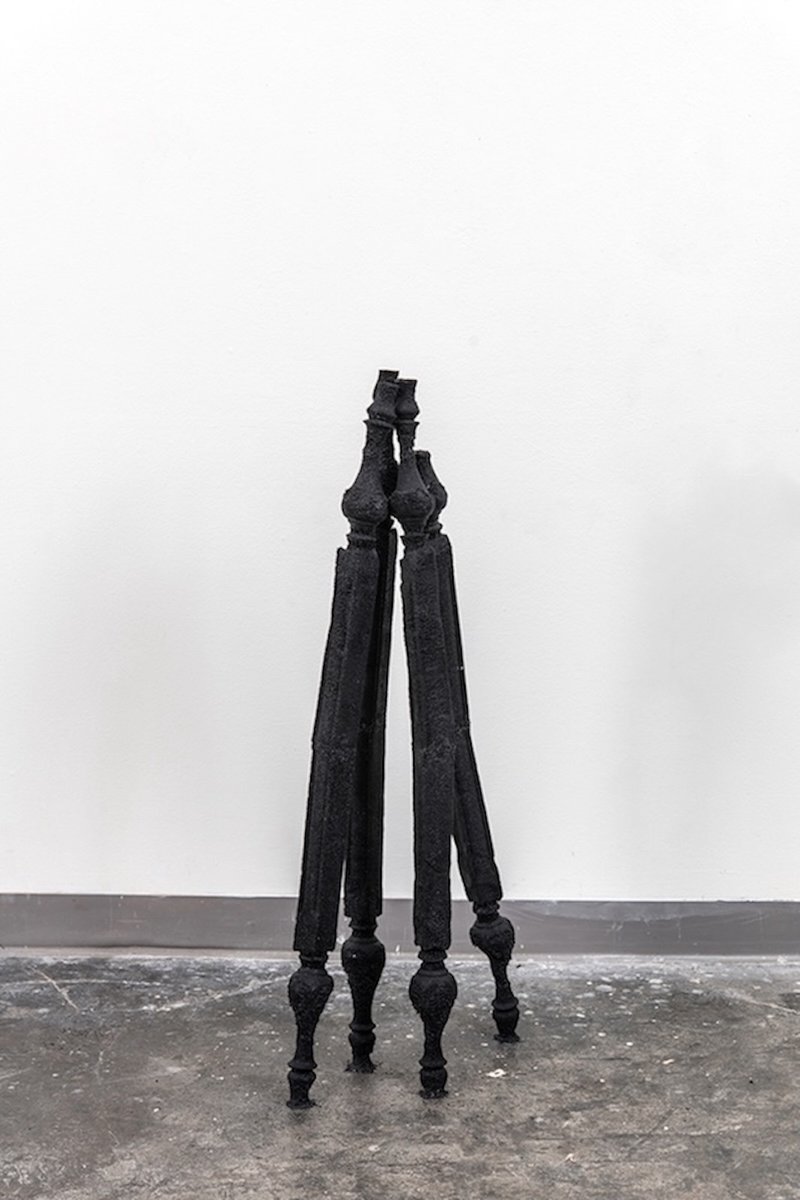
A clear example can be found in my glass works, such as “Overgrown” and “I gave her all my legs to stand on,” where I experiment with kiln temperatures through processes like tack fusing or sintering. Rather than melting the glass into a uniform whole, these works allow each particulate or strand of glass to retain its individual definition, resulting in structures that are only partially stable. I sometimes joke that the works “shed” every time they’re handled. These material decisions challenge the aesthetics and hierarchies of the studio glass movement while resisting traditional expectations around permanence, refinement, and collectability. Most importantly, handling the material in this way allows the work to embody emotional states that feel brittle, volatile, or unresolved, expressing something beyond language.
If you could share a meal with any artist, living or dead, who would you choose, and why?
PLM: I would dine with the Burnt Asphalt Family any day of the week! The Burnt Asphalt Family is an artist collective founded in 2007 by Jessica Jane Julius and Erica Rosenfeld with the mission to create community-centric work that exists somewhere between art, craft, and design. Their work is a hybrid of dinner party, happening, and interactive installation, inviting participants to question ideas around consumption, entertainment, labor, and value.
What I value most about their work is the way they collapse the boundaries between artwork and social engagement. Through collaborative making and shared meals, they create spaces where care, conversation, and participation become part of the medium itself. Being involved in their projects over the years has deeply shaped how I think about community and collective labor within my own practice.
Much of your work explores the complexities of love, power, and desire, especially where language fails. How do you express these ideas through your materials or visuals?
PLM: While my work often engages with the failure of language, I also approach it through satire and material translation. In “Gaslight,” I created a literal gaslight made from neon tubing that displays a phrase once said to me after I confronted someone about the harm they had caused. By transforming the phrase into a glowing, cold object, I made tangible the subtle violence of manipulation and emotional invalidation. The piece embodies the tension between illumination and erasure, certainty and doubt.
This interest in language and performance also extends into my video collage “The Sorries,” which investigates the politics of apology through found footage and repetition. The work considers the gendered dynamics of over-apologizing and asks how cultural expectations shape both accountability and emotional performance. Interwoven throughout are personal reflections around responsibility and repair: Who owes me an apology, and to whom do I owe one?
What are three books, films, or artworks that have really inspired you, your work, or that you’d recommend?
PLM: Bluets by Maggie Nelson for its fragmented approach to memory, longing, and emotional reflection; Manifesto for Maintenance Art by Mierle Laderman Ukeles for fundamentally shifting how I think about care, maintenance, and invisible labor as artistic practice; Figuring by Maria Popova for its interdisciplinary weaving of art, science, relationships, and ways of understanding the world through connection.


Paige L. Morris: Website | Instagram
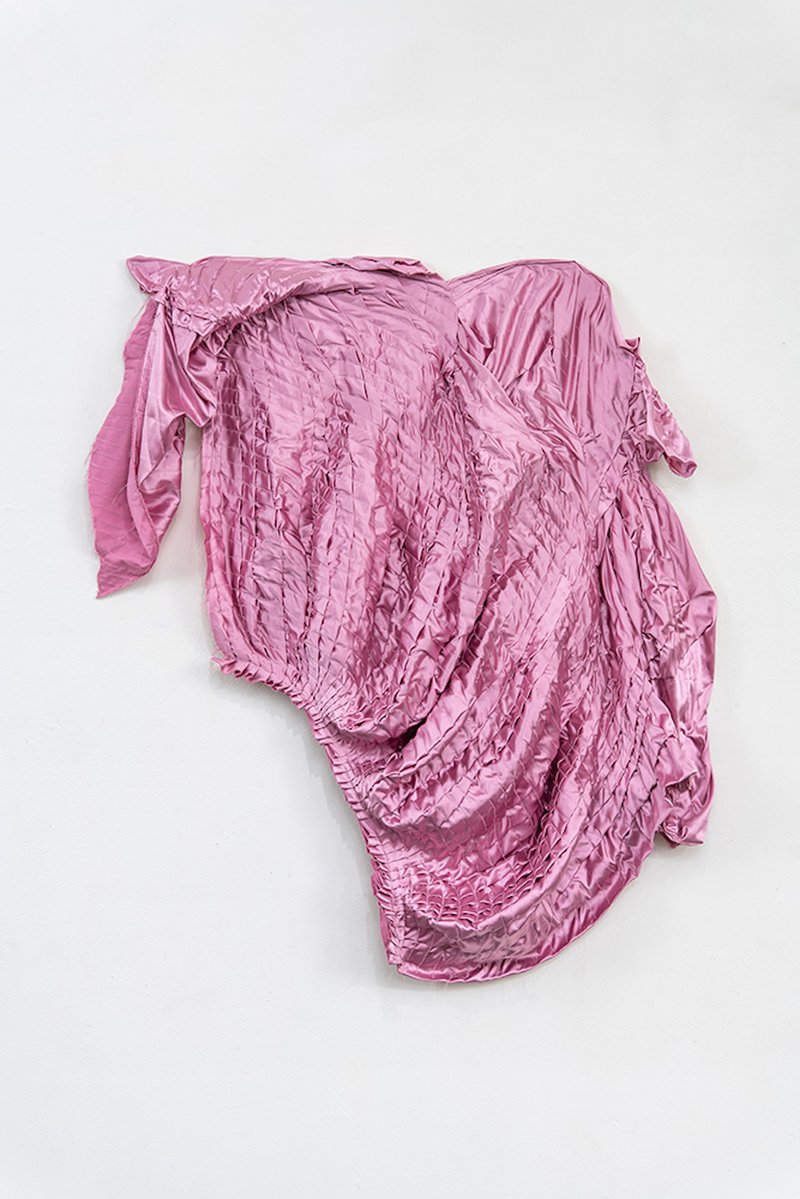
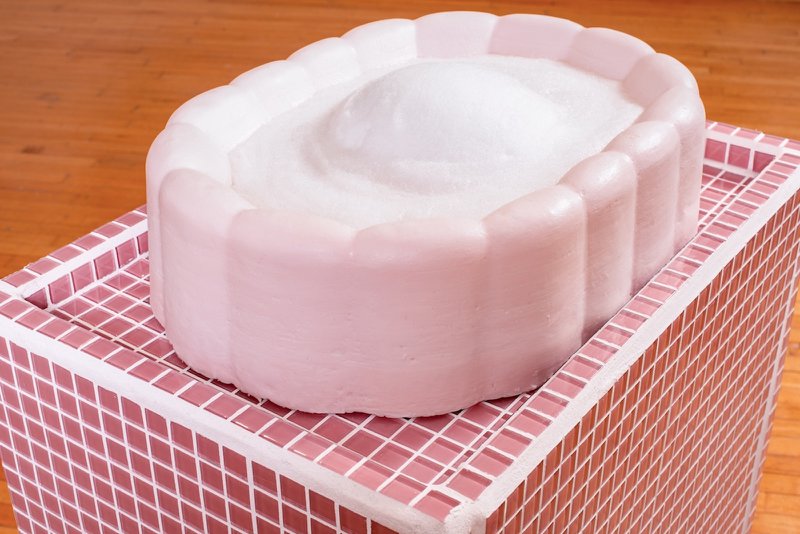
This interview has been edited for length and clarity. All images published with permission of Paige L. Morris; featured artwork: “Be My Little.”