


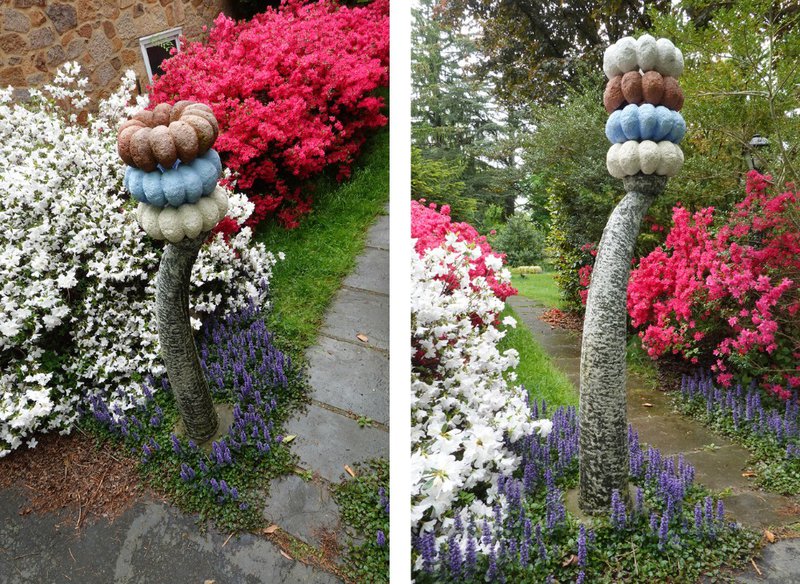
About 20 minutes outside Philadelphia, on a half-acre patch of land, four cement “bundt cakes”—dyed baby blue, cream, and red—are stacked on top of a bowed spire, like an offering to the gods. It would be easy to mistake Ava Blitz’s home sculpture garden for a scene from Alice in Wonderland or the pages of Dr. Seuss, if not for the artist’s house and nearby garage, which opens directly onto the yard. There, Ava’s finished pieces are exposed to the elements: sun, rain, the occasional hailstorm, and the fixed passage of time.
It’s a fitting setup for an artist who’s happiest roaming the land with a camera in tow, collecting impressions, textures, and the bones of future work. Adventure and experimentation are the driving forces behind Ava’s practice, whether she’s in a kayak or pouring cement straight into tarped trenches to create molds “born from the earth,” as she puts it.
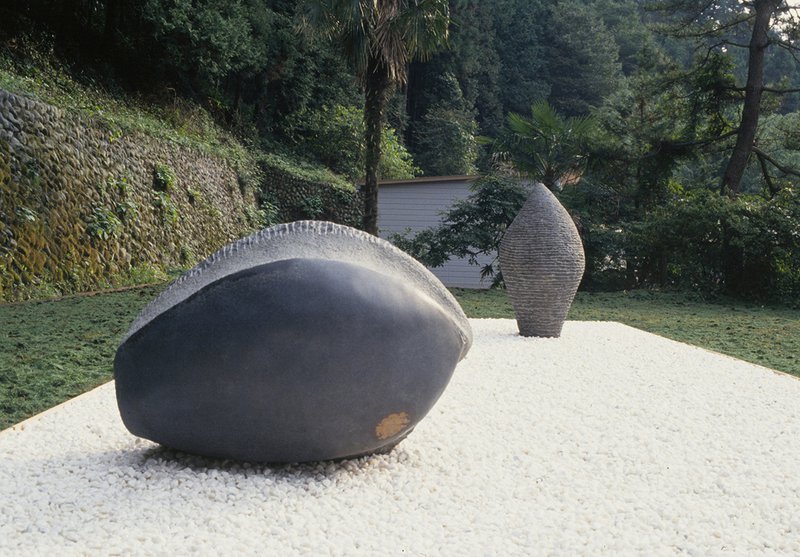
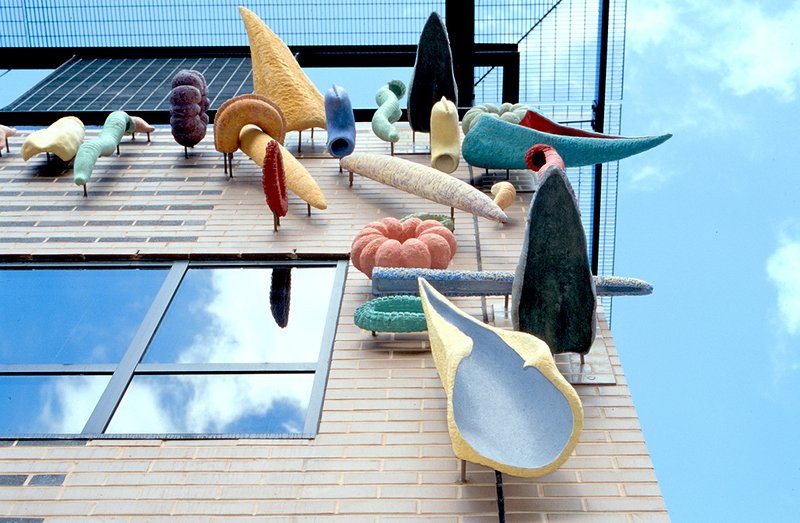
A formative six-month residency in Japan led to “Seeds of Memory,” a public sculpture garden crafted from Japanese basalt (dorokaburi, or mud-covered basalt), a stone prized by sculptors for its density, raw texture, and organic shape. Influenced by traditional Japanese raked sand meditation gardens and the tranquil mountain town where she stayed, Ava’s sculptures took on organic forms resembling seeds, buds, hives, and flowers—soft, feminine symbols of nature and growth carved into hard stone. She also experimented by casting several “fragments” from parts of the originals and installing them as if they were growing directly from the earth, left unprotected against the elements. “This area of the installation was meant to eventually become overgrown,” she explains, “while the concrete would pit, crack, and weather, further suggesting growth, change, and the passage of time.”
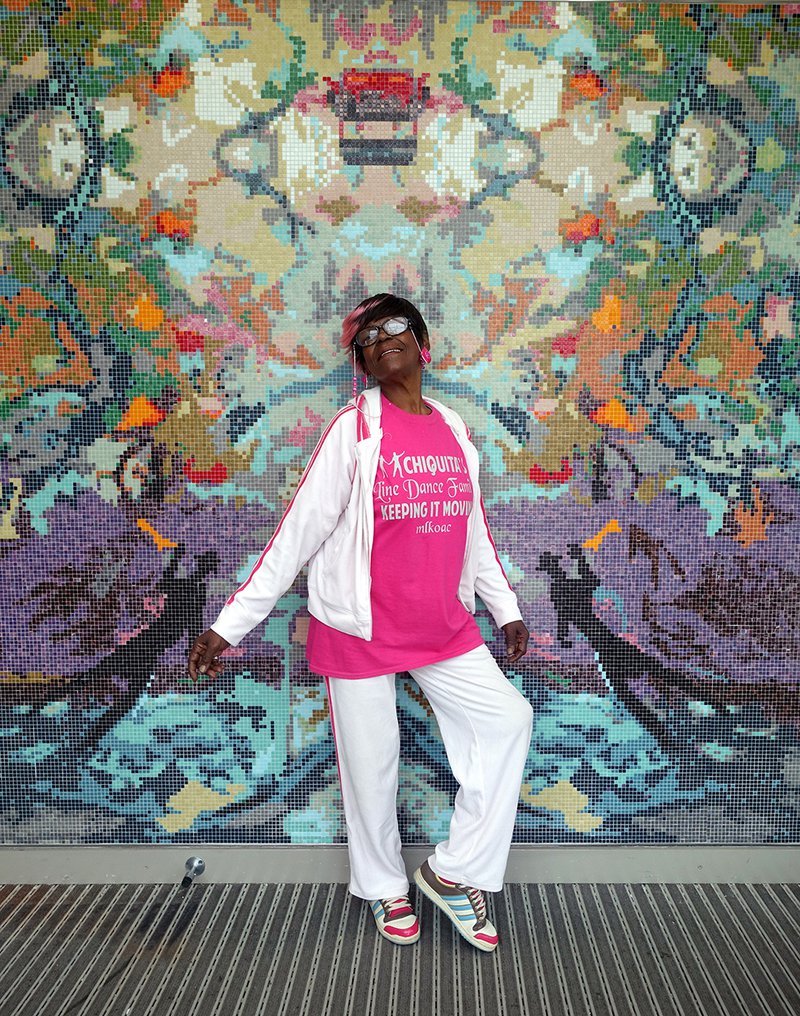
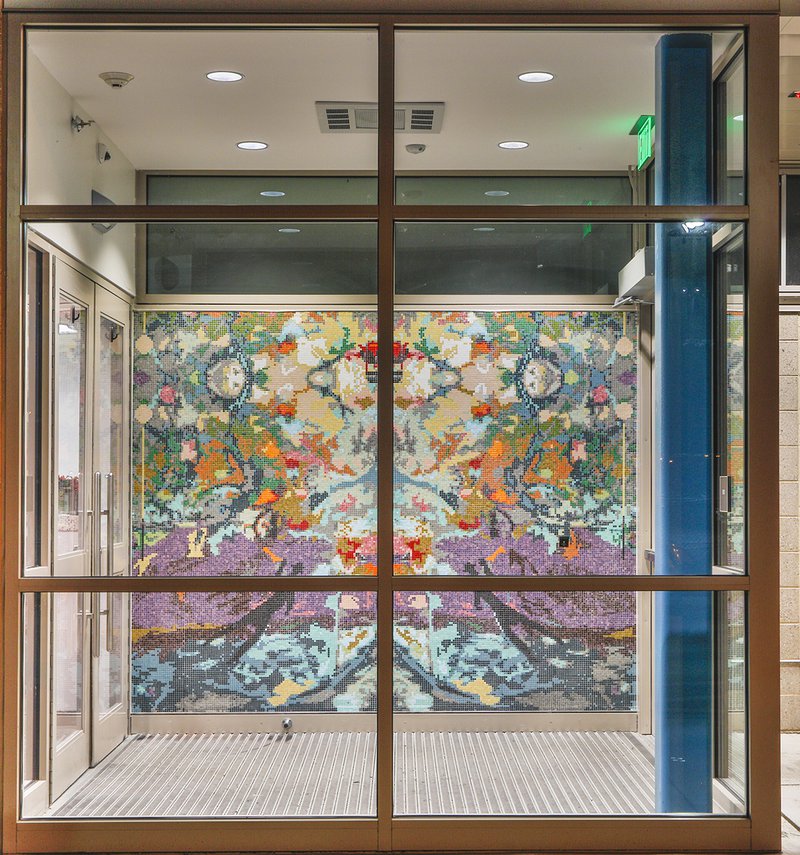
Ava’s thematic focus on repetition and modularity surfaced again in her community mosaic, “Flying Carpet,” selected to represent Pennsylvania in our summer exhibition with CODAworx, 250: A Celebration of Public Art in the U.S. Created for the Martin Luther King Adult Center in North Philadelphia, in partnership with the city’s Percent for Art program, the industrial glass mosaic weaves digitally manipulated motifs from nature into a pattern reminiscent of cozy textiles, bringing the natural world into an urban setting. The work contains hidden symbols that nod to activities at the center: billiards, cards, dancing, and bus trips—everything that makes the center feel like a home away from home.
In Today’s Q+Art Interview…
Ava Blitz reflects on blending Eastern and Western influences in her work, shares insights into her piece for our summer exhibition, 250: A Celebration of Public Art in the U.S., and explains why the landscape remains a uniquely inspiring subject for her creative exploration.
How did your ‘Flying Carpet’ mosaic come together?
Ava Blitz: I met with the clients at the center and asked, “What does the center mean to you?” What they came up with is that, for them, the center is a home away from home. It's a place of camaraderie and a place to go and be safe. And there are lots of activities there. I also asked about the natural world. This is a very urban place; it's right in North Philly. When they thought of art, they thought of landscape; they thought of a beautiful place. That kind of fits with what I do because I work with the natural world combined with cultural tradition. I came up with something from the natural world, but turned it into a repeating pattern, so that it had the feeling of rugs and textiles, cozy quilts, the kind of thing that’s welcoming. It's right in the entryway, so it gets a lot of traffic.
When you're working on public art projects, you're talking with the community. Do you have a preferred method for collecting information, or does it change every time?
AB: It does change every time. The more I get to know the community, the better. I really do enjoy that because then the project becomes “they.” The community participates, expresses their interests and ideas, and it all comes together into something everybody has created.

Did you interact with or involve the community at all during your residency in Japan?
AB: The Japan Foundation brought artists from all over the world together in these different communities. The sculptors worked right outside Tokyo in Hinode, a lumbering town. In a way, we were isolated, but the locals, in particular the women, brought me into their culture. They dressed me up, and I danced with them during a festival. It was really lovely. The piece I created—the concept is a combination of East and West.
I like to work with material and process, but also culture and cultural tradition. For [“Seeds of Memory”], I made these very organic forms set on a white gravel bed, like the Japanese Karekansui, the rake gravel gardens, but with straight-edged borders. So the piece combined the two ideas.
For somebody who's unfamiliar with some of those aesthetics or philosophies, can you explain which ones have inspired and influenced your work?
AB: For sculpture, the elegance of these gardens. They're very minimal, and they have natural rocks. They're serene, they're contemplative, they just inspire peace. For the 2D work, I studied and taught printmaking, including etching, woodcut, silkscreen, and lithography. Of course, the Japanese are wonderful printmakers. Artists throughout recent times have been influenced by these beautiful woodblock prints because of their simplicity and the way they're cropped. Unusual cropping, unusual point of view, sometimes aerial, the sparseness, simple shapes, but also the idea of man is this tiny part of nature in harmony, but definitely not the most important thing.

How did your work change when you returned from that residency?
AB: We all did large-scale, architectural-scale sculpture, and it was left there. It's permanent installations, I presume. And I brought back some molds. So the idea of repetition, even in the mosaics, the repetition of tiles, the repetition of mark-making in painting and drawing, the work in series of printmaking, and with sculpture, the repetition of casts. I like to cast multiple pieces to create new pieces.
They become the building blocks, whether they're block-shaped or not. One thing I haven't done is an architectural folly, a big structure of building blocks. My reliefs were originally carved in stone, but I made molds and cast them; I'd like to use them as building blocks for an architectural structure built to match the landscape. It could be an igloo form.
One of your pieces, ‘Beauty and the Beast,’ is installed on a very flat patch of land in New Jersey and appears to sprout from the ground. Can you say more about how you approach your site-specific work and how it’s so integral to the landscape itself?
AB: I'm a big hiker, and I go on adventures, canoeing, kayaking. I like to explore the landscape. I love exploring cities too, but the landscape is something special for me. For “Beauty and the Beast,” the landscape was a flat plane, and instead of making a monumental, huge sculpture, I thought to preserve that feeling of flatness. New Jersey is very flat. In order to keep a sense of the flat plane, I put the work underground. These spires are five feet high, but three feet of it is underground. From a distance, you almost don't see it at all. As you approach, it feels like they are growing as you see more and more of them.
It's interactive in that way. It's also a gathering place. It's an art and music camp, and people play music there; you can go inside, jump inside, and walk in among the spires. It’s a metaphor for birth, growth, and a return to earth.

Ava Blitz: Website | Instagram
This interview has been edited for length and clarity. All images published with permission of Ava Blitz; featured artwork: “Beauty and the Beast.”