


Q+Art is a series featuring the artists behind our First Friday Exhibitions. Today, we’re talking with Rhode Island-based artist Carol Scavotto, whose work is featured in our May 2026 exhibition, Modern Love: Reflections on Intimacy and Eros.
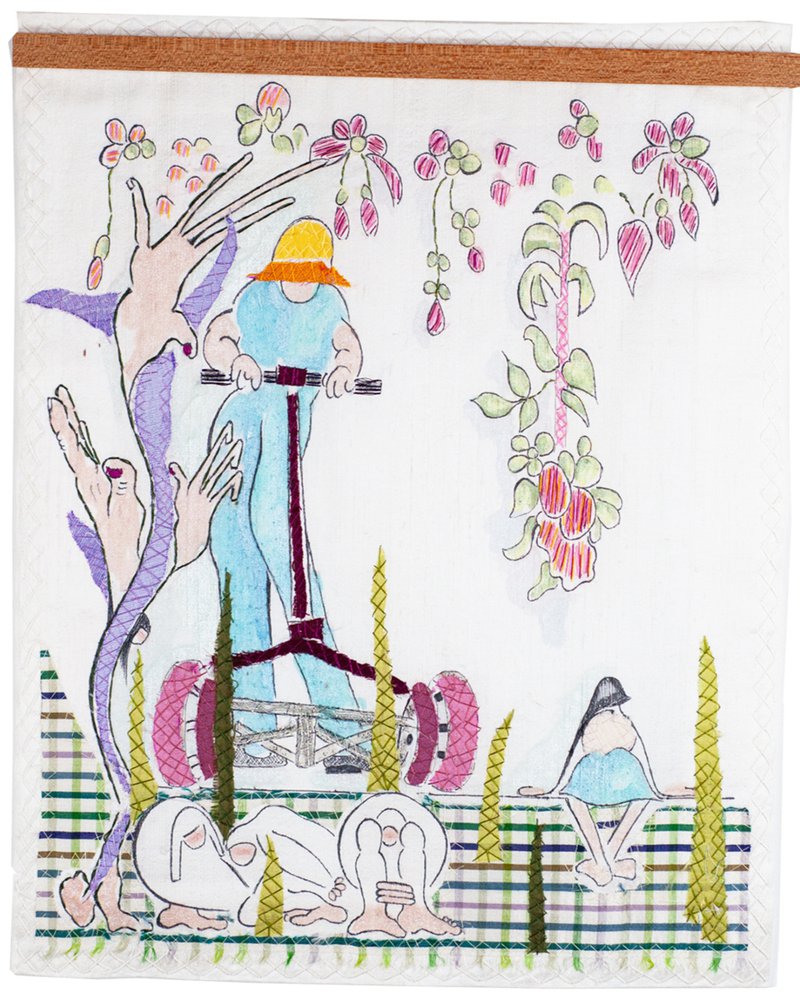
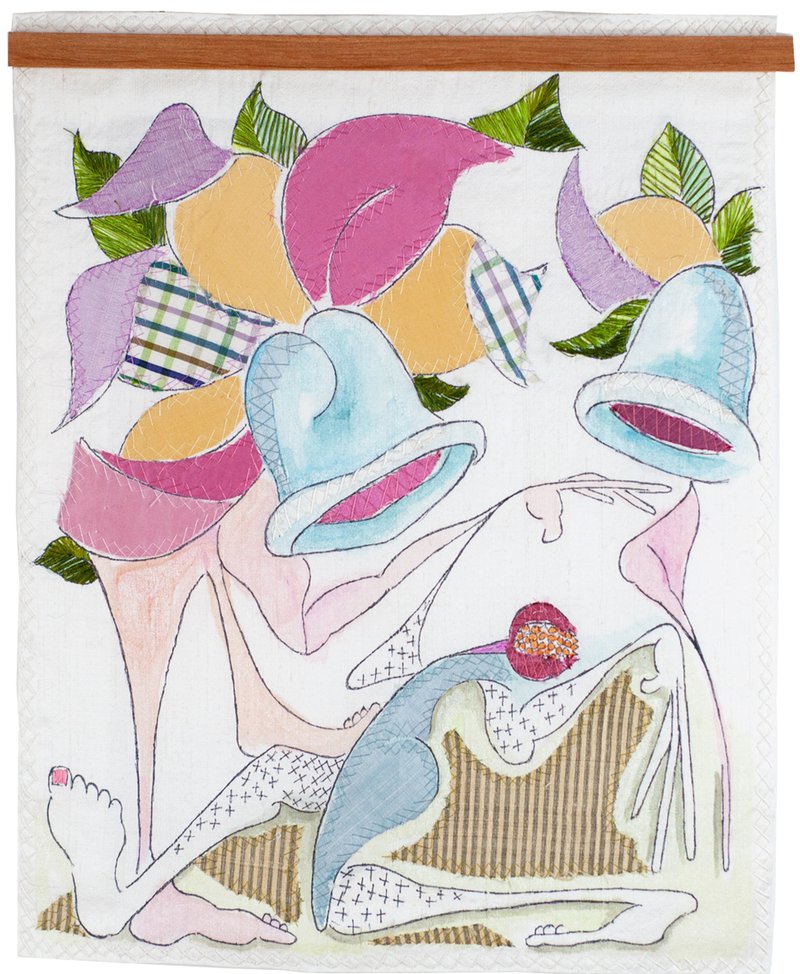
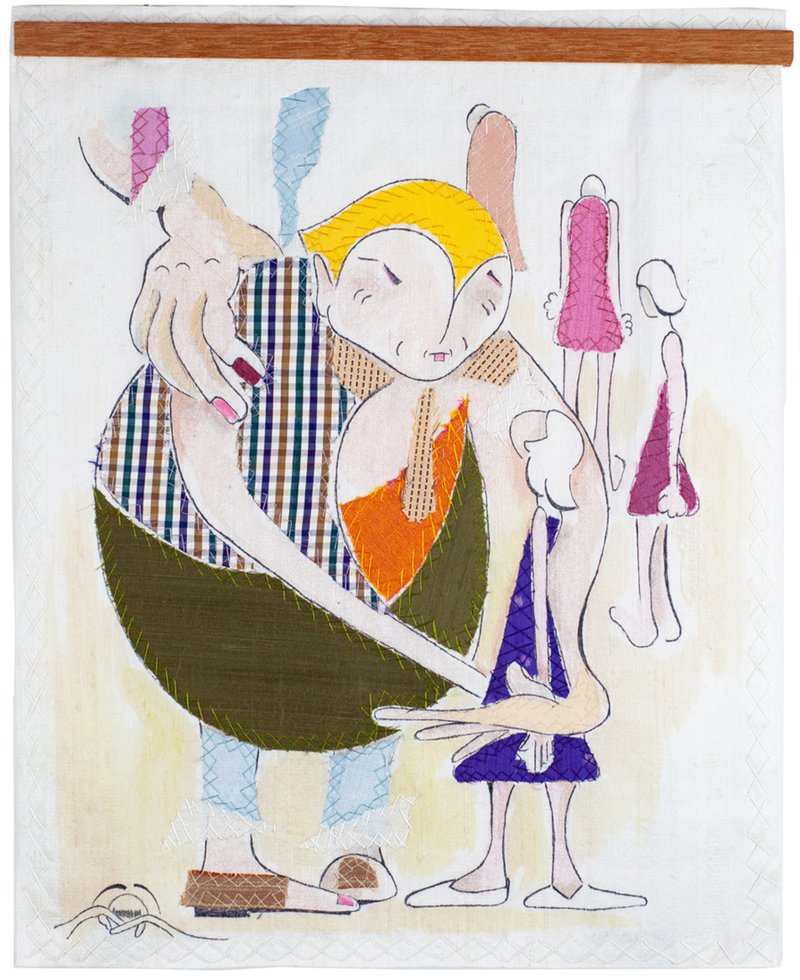
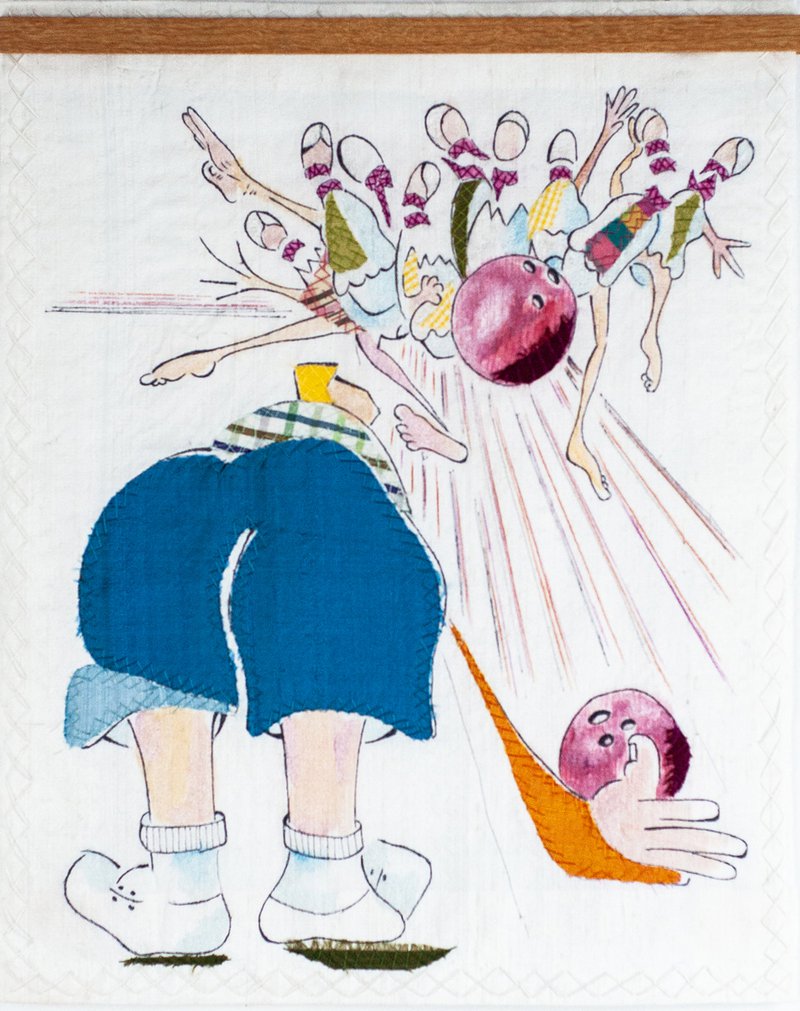
Carol Scavotto’s hand-embroidered figures—stitched into crisp white dupioni silk, blushing with faint washes of color, and grounded by the fabric’s slubby, uneven surface—lose something vital when flattened into a JPEG.
For Carol, softness and subtlety are casualties of digitization. As the Rhode Island artist puts it during our Zoom call, “You don’t always get a true sense of an artist’s work by seeing it digitally. We could be sitting here talking, and you might be wearing a $500 silk blouse from a designer store, or you could have picked up a $12 white shirt with a collar from Kmart on your way over. Digitally, I probably wouldn’t be able to tell the difference."
Digitization may be the price of admission to the digital commons, but for an artist working with material as delicate as silk, the trade-off is clear: access without intimacy, speed stripped of aura. Yet Carol’s narrative silk paintings are saturated with both. The materials murmur, but the subject matter shrieks, laughs, and even lusts through a loudspeaker. Her decorative, often sensual works draw directly from Asian traditions, particularly Chinese embroidery, the Kama Sutra, and Japanese shunga—erotic woodblock prints that, in their heyday (1600–1868), depicted ordinary people caught in moments of intimacy with humor, wit, and curiosity.

Carol’s work moves in the same register, though a red high heel or some other “American” symbol sometimes slips into the frame (see “The Commuter” above). She riffs on tradition, but always with a sly aside: petals stand in for anatomy, gestures evoke the poise of a dancer, and women refuse to recede into the background; here, their subjectivity and pleasure are the axis around which everything else turns.
Recently, Carol’s work has taken a darker turn, the subtle eroticism edged out by imagery she calls “subtly political.” “The world has become so angry… It’s almost impossible not to feel negativity from any direction,” she notes. In her latest series, The All-American Woman, flowers that once leaned toward each other now adopt postures of aggression—bristling, sparring, even choking one another. The palette remains soft, but the implications harden around the women, who are just trying to tend their gardens in peace. Somewhere in the background, an orange figure lurks, unnamed but unmistakable. “This series isn’t about men against women, or blue against red,” Carol insists, “but a fight for presence, autonomy, and a voice” in a culture intent on muting them.
In Today’s Q+Art Interview…
Carol Scavotto reflects on a childhood shaped by Japanese art, the secret language of flowers in her work, and why her practice has moved beyond the purely erotic. Scroll through to read our interview with Carol, then view her work in Modern Love.


What drew you specifically to Asian art and shunga as inspiration?
Carol Scavotto: Growing up, my mother had a lot of Japanese art. It was always there. As a kid, you didn’t think to question your mom—why would you paint your bedroom in Asian pink and black lacquer, and choose those drapes? It was popular in the ’50s and ’60s, so that was how she decorated, including much of the artwork she bought. By the ’70s, she had changed her house a lot, and it had become mid-century modern.
Can you describe the origins and cultural context of shunga?
CS: Shunga books were very, very common in Japan. They were not considered obscene in any way. The work is more than suggestive, but it wasn’t seen as such—it was just beautiful. What’s unusual about shunga is that the head and the genitals are intended to be the same size, of equal importance. That’s why their bodies are often extremely contorted. Knowing all that, I let my figures take any shape. I didn’t want my work to be erotic pornography, so that’s where the flowers came in.


How did you come to work with embroidery and silk as a Western artist drawing from Asian traditions?
CS: When I was 12, everyone was wearing cool clothes, but I couldn’t find anything that fit me the way I wanted. So I learned to sew. I never really liked sewing, but it was okay because I could make a dress with fabulous material. It’s always been part of my life. In college, I spent a lot of time learning embroidery. For a 3D class, I made a shirt and covered it with embroidered flowers.
How has your work been received by Asian viewers, and what do you think of accusations of cultural appropriation?
CS: I had a big show in Brooklyn in Sunset Park, where there’s a big Asian community. I think there were 15 to 18 Japanese people who came to my artist talk as a group. They were very reserved and quiet until I said, “So what do you think?” Once they became comfortable, it was really a very cool experience. I even asked if they considered my work an appropriation of their culture, and they said no. Then they looked again and said, “But we’ve never worn those red high heels!” There’s so much Western ideology in my work that doesn’t fit with Asian culture at all.
In Providence, where I am now, I just had a smaller version of the show. I opened the door completely by asking for responses, and three young Asian men were upset by the work…fair enough. Whatever response you have to my art is valid.
What’s the focus of your current series? How has your subject matter shifted from eroticism?
CS: At one point, the erotic series was really feeding me. If it’s not feeding me, then a series ends. I was working on them as the world was becoming angrier. Flowers began to turn into people, and the flowers grew aggressive toward each other.
The name of the new series is The All-American Woman. I don’t usually name series, but this one is about what we are being forced to become. It’s like they’re trying to put us back in a box and put our bras back on.
Feminism and female empowerment seem to be woven through your work, including your erotic and narrative pieces. How do you approach this focus in your art?
CS: If you look at my figures, some are ambiguous as to whether they’re male or female, but in general, they’re almost all female-based. The female is the dominant figure in every one of them. Even the new series [The All-American Woman] is still a very sexual thing, as far as what I’m addressing: women being squished down. It’s essentially still the same conversation.
View ‘Modern Love: Reflections on Intimacy and Eros’
Our May 2026 exhibition features work by Carol Scavotto.
Exhibition | Curator’s Statement
Follow Carol Scavotto
Website | Instagram | Facebook | Etsy
The interview has been edited for length and clarity. All photos published with permission of Carol Scavotto; featured artwork: “Bird Fever” (detail).