


The relationship between art and resistance is nothing new and often predicts the direction art will take next. As mainstream as they might seem today, Renaissance artists and the Impressionists were downright iconoclastic when they pushed back against the status quo. Whether protesting Medieval flatness and Church control or rejecting the rigid standards of the French Salon, these creative rebels ushered in a whole new era. Applied to shadowy figures risking their lives to subvert the Nazis, the word “resistance” conjures suffragettes fighting for the right to vote, civil rights activists, marches against the Vietnam War, the Stonewall riots, women burning bras, Occupy Wall Street, Black Lives Matter, and fights for human rights at home and abroad. To quote Isaac Newton’s Third Law of Motion: “Every action has an equal and opposite reaction.” In keeping with the laws of physics, the tension between what is and what could be keeps art from standing still.
With the midterm elections as an impetus, The Art of Resistance features a committed array of artists working behind the scenes to inspire us to action. Like a simmering volcano, the work in NOT REAL ART's fall exhibition urges viewers to look beneath the surface and ponder the ramifications of climate change, gun violence, racial- and gender-related profiling, election conspiracies, immigration issues, a flailing economy, and corporate greed. From a mangled Duchamp-inspired bicycle calling out police violence to a shimmering quilt questioning the impartiality of the U.S. justice system, this incisive selection of work demonstrates art can be persuasive, innovative, and engaging. As these artists explore issues they feel passionate about, they’ve created compelling visual statements that shed light in the darkness and stand on their own—by no means an easy thing to do.
View The Art of Resistance, then scroll down for details about the artists and their work.

Activism, Conspiracy Theories, and Human Rights

Beth Grossman’s video “Dominoes” feels acutely relevant today as democratic principles fall before our eyes. In “I Got Some Tattoos This Year My Momma Wont Like Them” and the installation “Reeds,” Larry Li and Anahita Bagheri address the aftermath of human rights protests in China and Iran on a personal level. Megumi Nakazawa’s enlightening grid of oil portraits with audio, “Faces of Mass Incarceration,” focuses on individuals impacted by the criminal justice system and the systemic failures behind it. Featuring flags, eagles, and guns, Ethan Minsker’s “American the Fragile” unpacks the complacency and vulnerability of a country used to thinking of itself as “number one.” In “IT WAS A RIGGED ELECTION,” Janet Kaplan uses a digital cross-stitch motif to explore how the myth of a stolen election has been woven into the fabric of American life. In “I See You,” a mixed-media portrait of artist and activist Loni Berry, Lydia Boddie-Rice honors transformative figures who break barriers and inspire change.
Roe, Gender, and Race
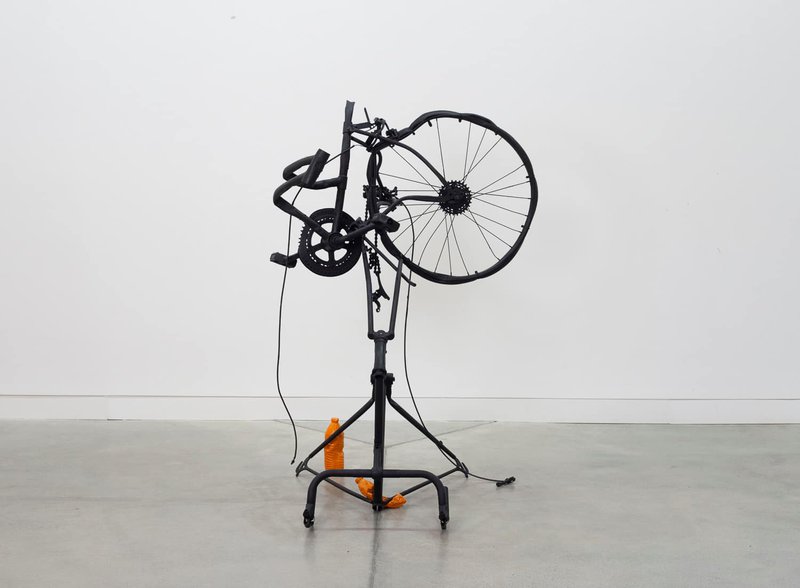
Njari Anderson’s sculpture “Beat Me, Pin Me, Bend Me, Shoot Me, 'Shoot Me,' Hold Me, 'Hold Me Down,’ (Repeat)” puts a Dadaist spin on a chilling allusion to police violence. In the photograph “Don't Touch My Hair (D.T.M.H.),” Alfield Reeves spotlights the fetishistic othering of Black women and the urge to touch or comment on their hair. Aynex Mercado’s “Blind No More” uses the image of a fleeing Lady Justice to convey her loss of faith in judicial fairness. In “Imagining Roe,” Coco Spadoni invites viewers to reflect on her experience of becoming an egg donor the year Roe v. Wade was overturned, and how those two events intersect. Lineadeluz and Shawn Huckins take on gender stereotyping in Lineadeluz’s “Cry No More” and Huckins’ textile-enhanced portrait “John Hancock (After Copley).” Paying homage to the little boy he never had a chance to be, Jacob Clayton transforms himself into a graphic hero battling for trans rights in “Supertran.”
The Environment, The Economy, and Corporate Greed

“The Rape of Gaia,” an arresting tableau by David Hubbard, shows the Goddess of the Earth being ravaged by the oil industry and calls out relentless attacks on the environment by unfettered corporations. In the photo montage “Gucci,” Andrew Soria juxtaposes a homeless tent encampment with a luxury boutique to illustrate the exploding gap between poverty and wealth. ttdkwta’s futuristic “paycheck2paycheck.ttd,” warning “our survival is more important than your bonus,” seems acutely timely in an era of corporate layoffs and crippling stagflation. Quinn Keck’s witty letterpress print “Don't Play the Role Capitalism Assigned You” questions the logic of blindly following the system. “Conglomerate,” a pencil drawing by Kenn Kotara, uses ominous images of mushrooming clouds to symbolize corporate expansion and systemic control. “Cross X Roads,” an installation of ceramic artifacts by Danielle O’Malley, describes our relationship with the natural world as a “tangled mess” and asks where we go from here.
Migration, Family Separation, and Guns
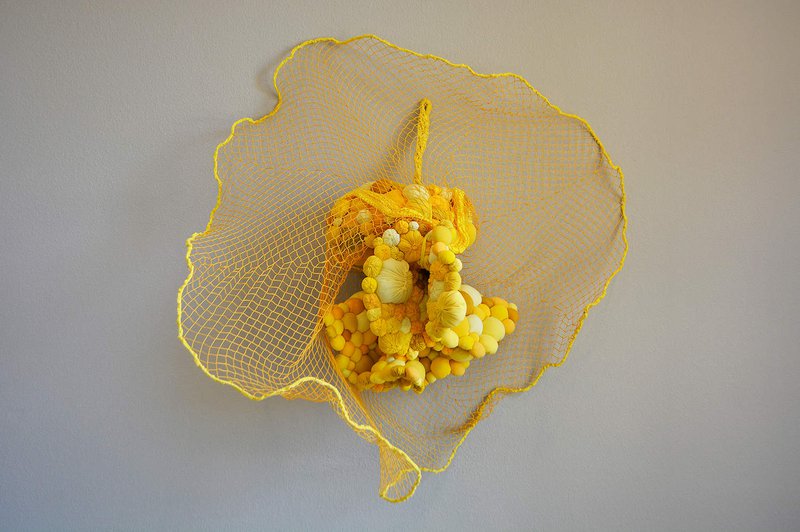
Merging a Chinese folktale character with the Statue of Liberty in their painting “Statue of Immigration,” creative duo Lily Honglei ponders the cruel irony of a beacon for immigrants becoming a symbol of family separation. Focusing on the statue’s hand to reveal cracks in the American Dream, Mr. DVMO uses snippets of news clippings to reference traumatic events and warn against complacency in “Reach and Change.” In the textile construction, “Hive,” Mônica Lóss combines sewing, fishnet techniques, and found objects to explore permanence, displacement, and the loss of identity inherent in immigration. Jane Allen Ingram’s “Seven Children,” from her Guns into Flowers series, incorporates daily statistics about violence against children to urge viewers to reconsider their position on guns.
All images published with permission of the artist(s); featured graphic editing for The Art of Resistance by Elise Wilson.