


As I admire the murals in my historic Richmond, Virginia, neighborhood, many of which blossomed during the same era the Confederate statues on Monument Avenue came down, I can’t help thinking how the contradictions of my adopted city reflect our nation’s complex past. As we celebrate the 250th anniversary of the American colonies becoming a nation, with all its festivities, uncertainties, and rumination, it seems evident that the struggles for liberty and equal rights that led to the signing of the Declaration of Independence continue today. In partnership with CODAworx, the leading platform for the public art industry based in Madison, Wisconsin, I embarked on a thrilling virtual tour of murals, sculptures, and installations enhancing cities and landscapes throughout the 50 states, Washington, DC, and Puerto Rico, and was heartened by what I found.
Responding to the history and character of their locations, the 52 projects featured in 250: A Celebration of Public Art in the U.S. demonstrate the unlimited potential of public art to inspire, educate, and inform, as well as its symbiotic relationship with its cultural and geographical surroundings. From reconstructed slave quarters in Maryland to train tracks reaching to the sky honoring railroad workers in California, from an underwater art museum in Florida to a vibrant motivational relief at a youth correctional center in Alaska, this curated selection of projects dazzles from coast to coast. Whether referencing historical events, enhancing public spaces, honoring iconic figures, engaging with American landscapes, or offering multimedia experiences, the artists, designers, architects, and engineers behind them put their unique stamp on urban and rural areas, centering on history, community, and storytelling.
View 250: A Celebration of Public Art in the U.S., then scroll down for details about the projects.

History and Community
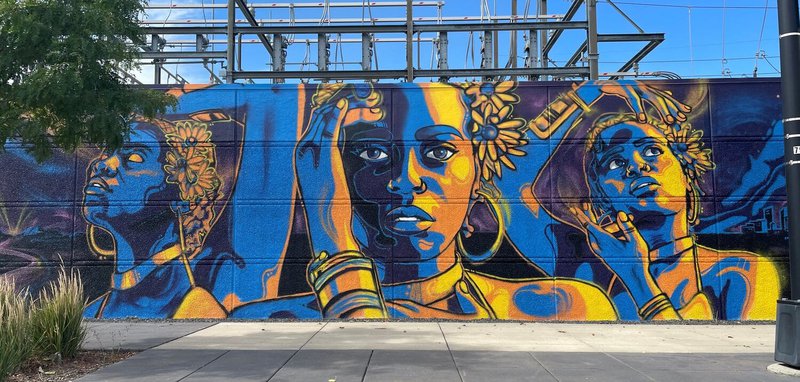
One of the first things that struck me while perusing hundreds of projects on CODAworx was the inherently collaborative nature of public art. Each project involves teamwork and coordination from concept to installation, not only among artists, fabricators, and design firms, but also with community members and local arts agencies. This focus on unity extends beyond the creative process. The uplifting “WE Mural” in my home state of Minnesota, commissioned by the City of Bloomington Creative Placemaking and created by a local artist collective, celebrates the vibrant South Loop neighborhood while foreshadowing the community activism and resistance to ICE seen in Minneapolis last spring. Numerous projects in 250 encourage people to come together, weaving in elements of local culture and history. Christopher Weed’s “Red Bass” celebrates the music culture of Athens, Georgia. Ilan Averbuch’s “Monument to Their Memory” in California honors workers who built the first Transcontinental Railroad. Lordy Rodriguez’s illustrated “BorderTowns” crossing in New Mexico and Blessing Hancock’s narrative sculpture “Loqui” in Nashville emphasize community and storytelling. RE:site’s architectural installation “From Absence to Presence, Commemorating Contributions of Enslaved Peoples” in Maryland; “Folding Stories,” Metalab’s suspended origami-like sculptures in a multi-cultural suburb of Houston; and Ai Qiu Hopen’s “Unity Arch Landmark” in West Virginia offer the community a chance to gather and reflect on unity, justice, and human rights.
Informed by the Land

Bridges, archways, sculptures, and murals inspired by a gorgeous array of American landscapes enrich both interior and exterior spaces throughout the country. “Foliage,” an elegant bridge by Cliff Garten Studio connecting two communities in Ohio, picks up the edges of the rolling meadows and forests around it. RE:site’s “Chromatic Passage,” a sculptural gateway at a botanical garden in Wisconsin, plays with natural color and form. “L'île Folie,” Marc Fornes’ whimsical canopy on a constructed island in North Carolina, blends fantasy and function while riffing on elements of the land. “Garden of the River” by Formed For/Brodin Sculptures in Michigan and Jessica Bodner’s “Flying Y Airport Sculpture Lenticular” in Montana are site-specific works that reflect and interact with the surrounding terrain. Lyubov Muravyeva’s rune-like “Soul of Stone” in New Hampshire, Matthew Mazzotta’s sustainable “Cloud House” in Missouri, and “La Veleta,” a totemic sculpture of stacked animal faces by Jaime Molina for Denver Arts & Venues, commune with nature on a spiritual level. Murals such as “Over the Valley” by David Carmack Lewis in Idaho and “Arkansas Heat” by Erin Ashcraft bring restorative views of rivers and lakes to urban locales. Gordon Huether + Partners’ undulating wall installation at Salt Lake City International Airport and Ball-Nogues Design Studio’s “Open Prairie” at the Johnson County Courthouse in Kansas blur the edges between indoors and out.
Iconic Figures

Putting a contemporary spin on the age-old tradition of public statues, “Stand”—Bollinger Atelier’s lacy cut-out figures of suffragettes by Barbara Grygutis in Kentucky—plays with the tension between fragility and strength. Stephen Whyte’s lifelike bronze portrait of civil rights attorney “Fred Gray” in Alabama conveys a similar nuanced message of fortitude and commitment. James Tyler’s “Groundwater Colossus,” a giant ceramic head atop an aquifer in Nebraska, reminds us that water is essential for human survival. “Jackson Hole Airport Entry,” a dynamic sculpture of a horseman by Bart Walter and G Brown Design set against the Grand Tetons, welcomes travelers to the only commercial airport in a U.S. National Park. Peter Diepenbrock’s alluring “Clock Man,” perched on a rooftop overlooking a busy highway, pays tribute to the laborers who contributed to the industry of Providence, Rhode Island. “Symphony in DC Major,” a trio of sculptural reliefs by Oxman Studio Inc., salutes Duke Ellington, Colonel Robert Gould Shaw, and Alma Thomas, key figures in the Shaw neighborhood of Washington, DC. “Three Trees: Jackson, Obama, Washington,” by Ignition Arts, LLC and Hood Design Studio, at the Chicago Cultural Center, presented a sculptural response to tensions surrounding the placement of the Obama Presidential Library on public land. “Stationary Figures,” Mayer of Munich’s whimsical ceramic mosaics of William Wegman’s Weimaraner portraits observing travelers in the New York subway, counteract the tedium of commuting while breathing new life into an ancient art form.
Immersive Experiences

By incorporating nontraditional materials, architectural elements, and new media into immersive environments, artists and designers nationwide illustrate how public art is evolving. From the Cultural Arts Alliance of Walton County’s mesmerizing Underwater Museum of Art in Florida to Narduli Studio’s dazzling “Virtual Sky” installation at the Oklahoma Convention Center, art becomes a holistic, multisensory experience. Marcus Brown’s “Human Universal Musical Sculpture (HUMS)” in New Orleans translates viewers’ bioelectric frequencies into sound. “River Constellation,” a responsive installation of illuminated orbs by BeauKenyon and Natalia Zubko in Iowa, combines light, music, and birdsong to foster meaningful connections with the environment. Transformit’s “SeaChange: Darkness and Light in the Gulf of Maine,” at the Maine Maritime Museum, simulates encountering a fragile marine habitat while advocating for its preservation. “Pulse Portal,” Davis McCarty’s cosmic structure harnessing sunlight in Nevada; Stephen Rhoades’ mirrored “Infinity Temple” in Vermont; and MASARY Studio's electronic installation “In Stillness” in Massachusetts, which responds to visitors’ movements, encourage reflection and engagement. Ray King Studio’s interior “Abacus” installation at Oregon State University and Ava Blitz’s “Flying Carpet” glass tapestries at the Martin Luther King Adult Center in Philadelphia offer uplifting aesthetic encounters for students, visitors, and residents by integrating art into quotidian spaces.
All images for 250: A Celebration of Public Art in the U.S. published with permission of CODAworx; featured graphic editing by Elise Wilson.